


In This City, Where it Rains and how it came to be

It can often be hard to pinpoint the exact inspirations for a piece of writing, but there were a few really distinct things that brought to life my new Scottish gothic horror novella, In This City, Where it Rains.
Ghostly waypoints
The first seed of inspiration came from an anthology I was commissioned to write a story for with Air and Nothingness Press’s: the Dérive. The concept of the anthology was to gather stories driven by the idea of psychogeography and the act of exploring a city in a nontraditional way. The dérive itself is an unplanned journey through a landscape, with explorers letting themselves be drawn by the attractions of the terrain and the encounters they find there. While brainstorming ideas, I had this very vivid image of a character using ghosts as waypoints in a city. It didn’t quite work for that anthology, and I went a different direction for that in the end, but the concept of ghostly waypoints stayed with me. I couldn’t stop thinking about why the character was using ghosts to navigate the city. This was the first chapter I wrote of the story, of Maggie traversing an alternative Edinburgh, navigating by the ghosts only she could see. The story morphed a little, but there was a magic moment in writing that first scene that I realised I needed to write Maggie’s story.
Curses, rituals, and the occult
The other seed of the book is something that had been inhabiting my mind for years from the first time I’d heard about it while on a writing retreat in the Highlands. This was the story of Boleskine House – a mansion with a complicated history that sits on the shores of Loch Ness – and its connection to the infamous Occultist Aleister Crowley.
Aleister Crowley was an infamous occultist and has sometimes been described as the “wickedest man” in Britain. He bought Boleskine House in 1899, where he was said to practice dark magic, altering the house to his needs. Then, during one of his rituals, communing with the dead, he was called away suddenly. As the local tale goes, he failed to close the break in the veil, causing the demons and spirits he’d summoned to remain. Since then, this was attributed to many strange happenings in and around Boleskine House.

Famously, one previous owner of the house was Jimmy Page from Led Zeppelin who learned about it from an experimental filmmaker who had rented it for a few months. He bought it in 1970 and left it in the care of a friend. However, his friend, who stayed there for years and raised his family there, claimed that the house was possessed by the devil.
There was a period of relative peace after this, so maybe the spirits had settled. But then after changing ownership again there was a fire at the house in 2015, and part way through another restoration process, another fire in 2019. Now in 2025, the house is owned by The Boleskine House Foundation, who were not put off by the fires or curse, and are seeking to return the house to its former glory.
While Tair House in the novella doesn’t entirely follow this history, there are pieces from the story that first began the threads of the book – and there are hints of the occult, of the veil between the living and dead, and family secrets abound in In This City, Where it Rains.
A city of eternal rain
Although I don’t name it in the book, my other major inspiration was Edinburgh – or a version of it, one cursed by a forgetting and eternal rain, (though if you’ve lived in Edinburgh before, you might question how much of a fiction the rain part is…) But the gothic history and eeriness that Edinburgh can evoke was the perfect inspiration for such a setting. I also love stories that mess with memory and perception, and so I wanted to present a warped version of Edinburgh, while keeping the eeriness and history intact.

A castle and weird moths
Finally, I wrote the novella during a month spent in Hawthornden Castle as part of a Hawthornden Fellowship – this was pretty much uninterrupted writing time, and is an experience I’d really recommend any writer to apply for. I wrote the book in what felt like a fever dream there, but as a result much of the house and descriptions resembled the interior of Hawthornden Castle itself – the grand rooms, the wintery chill, and of course, a pictish cave beneath its foundations that when explored we found it to be full of dozens of moths and spiders. The moths were the final part of the puzzle of the book, and the folklore around them as messengers to the otherworld, the land of the living and dead. The spiders remain unspoken about in the book (probably for the best).

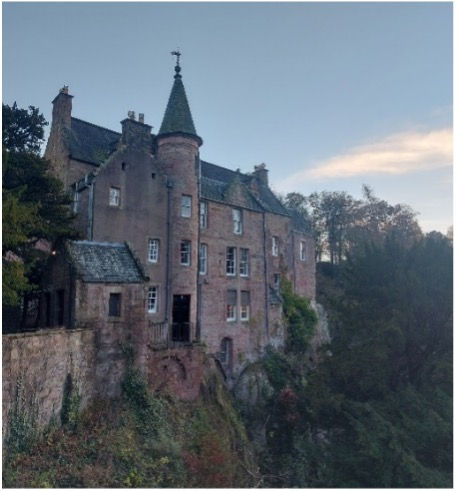
Hawthornden Castle. Image by Lyndsey Croal
One of the things I love about writing is when multiple threads come together and you get this lightbulb moment – that’s what it was like with the novella when I was able to connect all the pieces. I also wanted In This City, Where it Rains to hit some of the familiar vibes of the classic ghost stories and gothic fiction I love, but set between both the classic mansion and a sprawling city. It’s been an exciting journey to publish this book, and I hope people enjoy it if they pick it up next year!
Order Lyndsey's novella here!


Comments